His stats speak for themselves: six IHRA Pro Modified world championships, 28 IHRA Pro Mod national-event titles in 43 finals for a 65-percent win rate, plus countless match-racing victories and track records set over the course of two decades of doorslammer driving. Add to these accomplishments the 1999 NHRA Rookie of the Year award, two IHRA Top Fuel wins and serving as crew chief for his son Scott Jr.’s 2007 IHRA Pro Mod championship-winning season and it’s clear Scotty Cannon has earned every bit of the legendary status and respect he now enjoys from fans and competitors worldwide.
Editor’s Note: This story originally appeared in DI #66, the Nostalgia Special Issue, in June of 2012.
Growing up in Greer, South Carolina, from an early age Cannon worked hard in his family’s diner, aptly named Cannon’s Restaurant, where after 40 years in business, locals and visitors still sit down to enjoy the house specialty Southern-fried chicken and chicken livers.
Cannon recalls being at the restaurant “practically 24-7” after graduating only from ninth grade, but once he reached driving age he’d slip out during breaks and head to a nearby service station where the owner also kept a race car, just so he could watch and learn. “He wouldn’t let me work on it; I was too young,” Cannon remembers. “But I loved hanging out there.”
Back at the restaurant, though, Cannon met with the disapproval of his father, Virgil, especially after he began bracket racing in 1978 as a teenager with a then-brand-new Trans Am at nearby Greer Dragway. “If I was around him, we didn’t talk about racing; he would just always down it. He thought racing was a big waste of money. It was 10, 11 years of living through moral hell with him because he hated it so bad.”
Still, his father did lend Cannon enough money in the early-‘80s to build a tiny 16- by 24-foot shop to house his first real race car, a back-halved ’68 Firebird that set him on a straight path to international Pro Mod stardom and even made a believer out of his dad. “When I got to where I could make a few bucks at it, then it was okay,” Cannon says. “He became one of my biggest fans once I turned professional.”
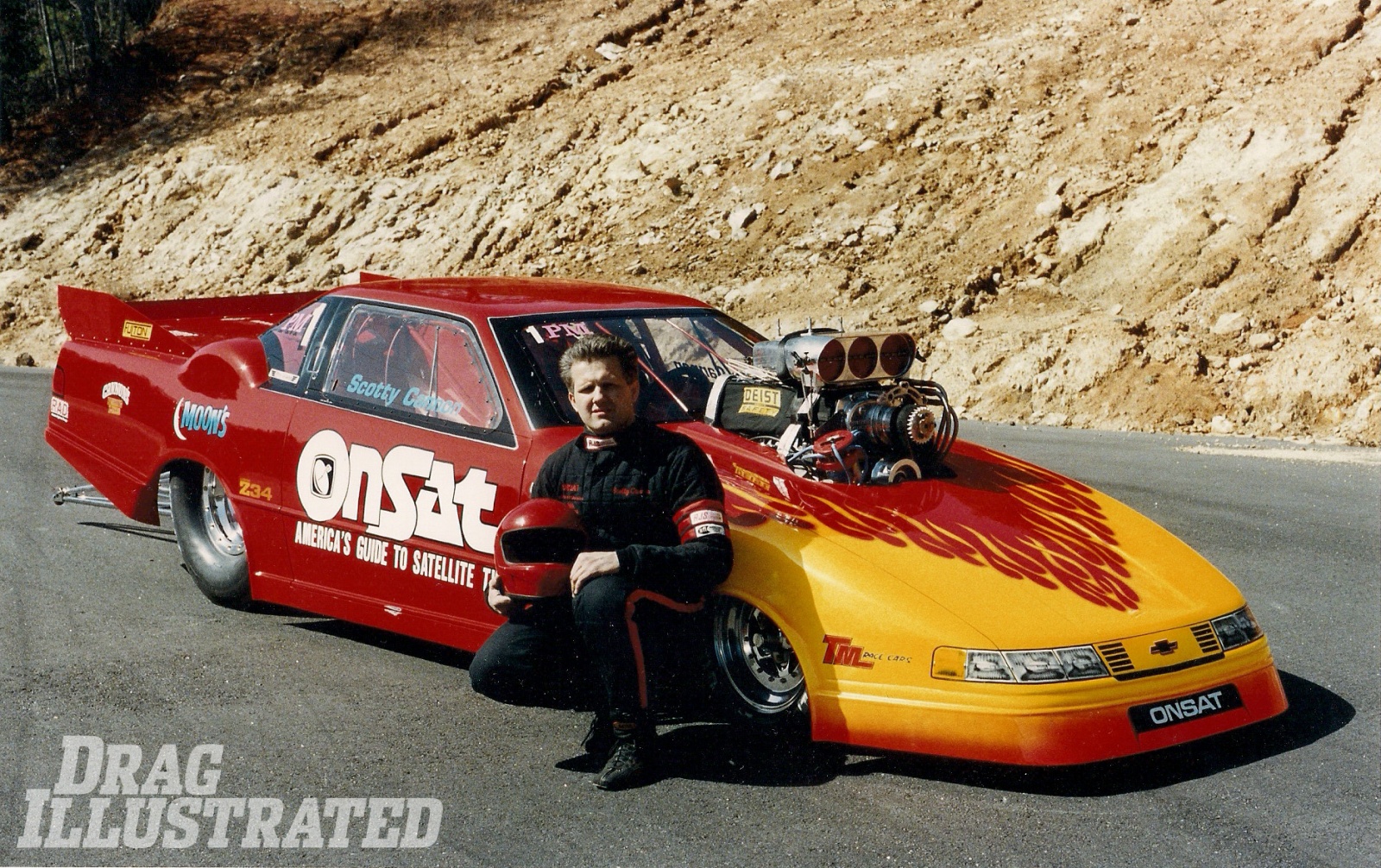
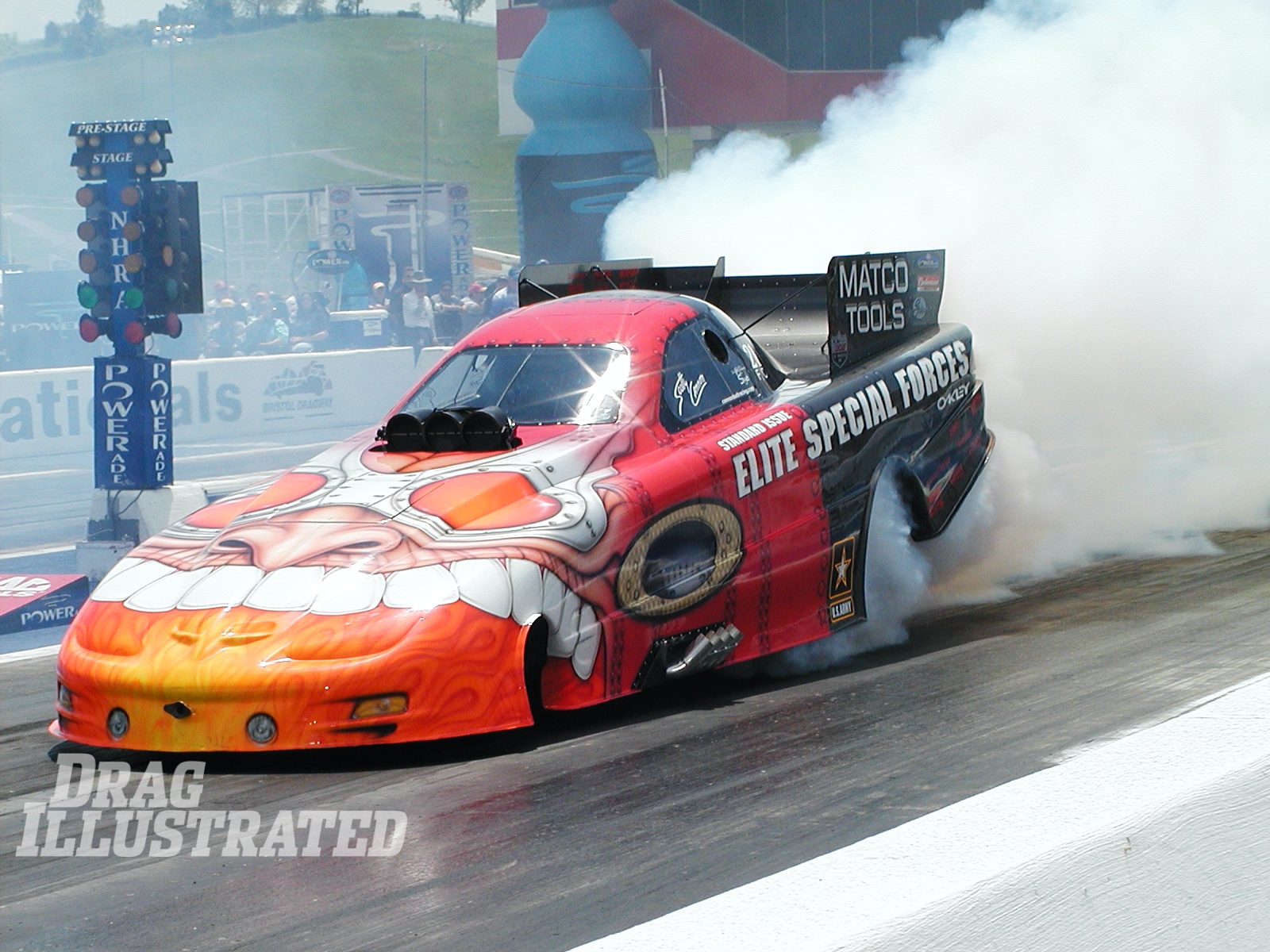
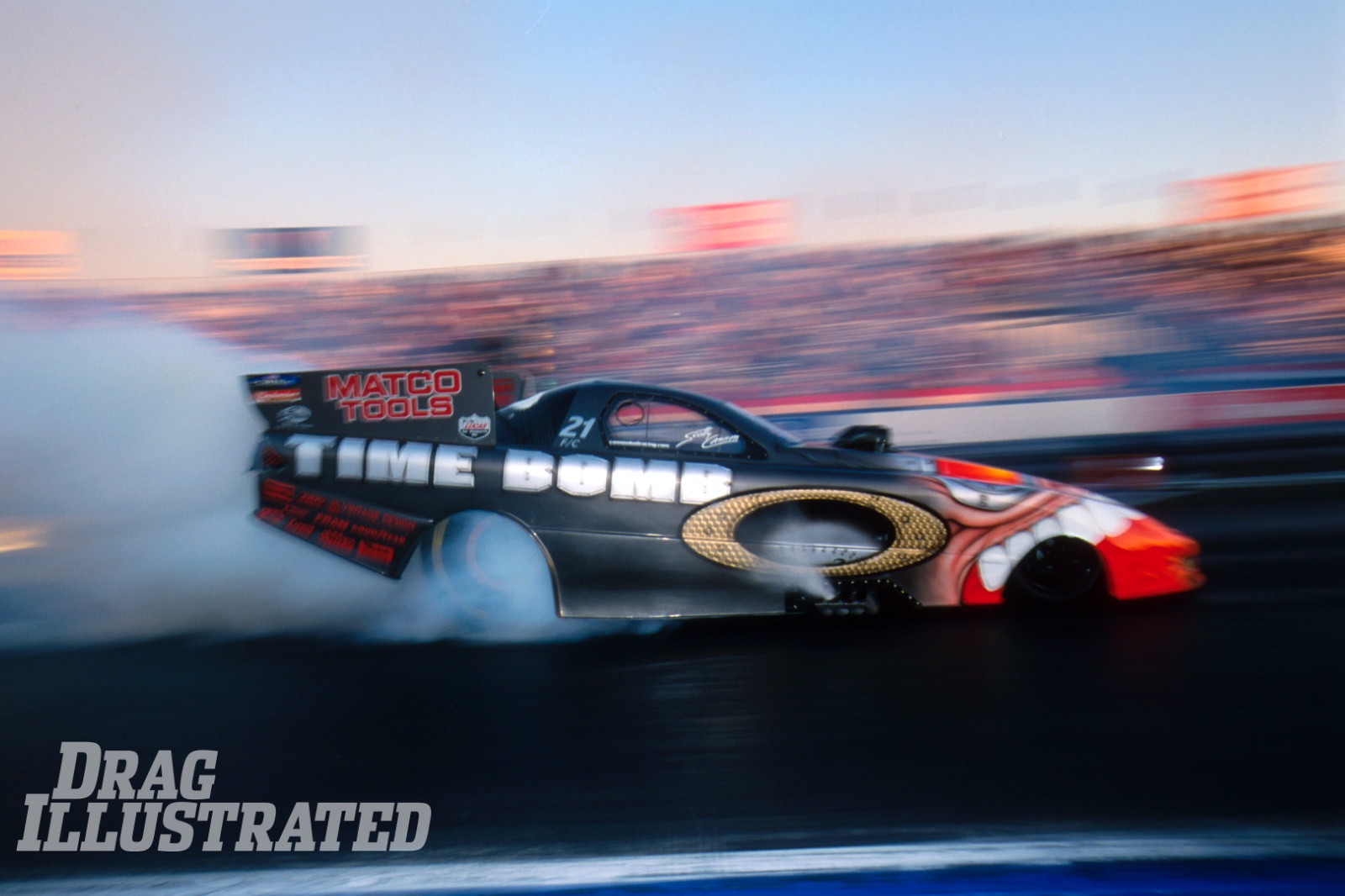
Cannon won four straight IHRA Pro Mod championships from 1991-94, got his fifth in ’96 and scored his final season title in 1998 before making the move to NHRA in ’99 as a rookie Funny Car driver. Though never managing to score a win in five years among the flopper ranks, Cannon continued as a crowd favorite in his Oakley-backed machine, partly as a result of his willingness to mix it up verbally with the stars of the day, most notably by challenging John Force before even turning a wheel in NHRA competition.
“What most people don’t know is that John knew what was going on and what we were doing was trying to set up a two-car match race and make a bunch of money,” Cannon explained in a 2005 DragRacingOnline.com interview. “We were going to race 100-percent heads-up, straight down the line, but to be honest, our car just didn’t perform good enough for it to happen.
“What everybody has to understand is that Scotty Cannon did not go out there with big balls to attack John Force. I caught a lot of flack off that, but to be honest; to all the critics out there I really don’t care. My fans that stuck by me, I love ‘em to death and I owe them everything I’ve ever got because if it wasn’t for them, people like (Oakley owner) Jim Jannard never would’ve believed in me neither.”
After the NHRA experiment, where a few too many bouts with tire shake took their toll on Cannon’s vertebrae and led to three corrective surgeries (the most recent being a year ago), he took some time off from driving to help get son Scott’s career up to speed. Last June he told Drag Illustrated, “Me watching Scott going up that track, I’ll admit I was a little nervous, but I got a lot of thrills and a lot of happiness out of it. It’s not the same (as driving), but I felt just as good as crew chief as when I was driving.”
These days, Cannon is back to helping run the family restaurant, but always remains open for a return to racing. He’s feeling much better, too, with his back finally getting the time it needs to properly heal and perhaps even allow a return to the cockpit. “There’s nothing I’d like better,” he told Drag Illustrated this April in a wide-ranging conversation that covered everything from his early years in the sport to some memorable moments to what needs to happen for drag racing to prosper in the coming years.
Were you good at racing from the start, or was winning something you had to learn?
I did pretty good, I think. I was bracket racing and this was before delay boxes and I was one of the guys to outrun. Looking back on it, I didn’t think I was doing that good at the time but it always funded what I was doing; it would stay where I could always race on the money I won, which wasn’t much, usually just $800 bucks or so.
But back then, there were a lot of people that helped me. I remember going to one of the junk yards one day and an older man that ran a wrecker service said he just picked up a ’68 or ’70 Corvette with a big motor in it and said to me, ‘You can have it.’ There was nothing wrong with the motor; it hardly had any miles on it and he gave me the motor. And that was one of my first race car motors. It was a 427, 425-horse motor and I threw it in my car to race it for two or three years. I got faster and I won. So it looked like I knew what I was doing, but I probably just got lucky. You’ve got to have a lot of luck.
Then I built that shop and I built one of my buddies a car. I didn’t charge him much; he’d come help me at the races, but the next thing you know, I start building cars. Back then, street racing was popular on Friday and Saturday nights. So I got to doing that.
And then the Top Sportsman thing was kind of brewing in the early ‘80s and then the Quick 8s and Quain Stott, me and him were buddies, he built me a car, I helped him, and that was my first Willys. So the Quick 8s around here, I got involved and there was one guy, Ronnie Barbosa, he got on board. He said he’d help pay for gas and tires, this, that and the other. He bought food, tires, paid for all the expenses and that kind of took a big load off me. It let me set my program up.

Was that your first sponsorship deal?
It wasn’t really a sponsor. He had his own business, and just wanted to go racing but couldn’t. What had happened was when we were bracket racing this guy had a race car and he wrecked it. He got hurt real bad at Greer and while he was gone to the hospital—we thought it killed him—me and my buddies loaded his car up and I took it home for him, about an hour away from us. Anyway, he heard all about what happened and he called me after the race. He had one of the faster cars and had like a 540 motor that Gene Fulton built in it, and he said he was going to give me all the stuff that was still good on his car, the converter maybe, the rear end and the motor.
Then he said he was going to miss racing, so I said, why don’t you just go with us and that’s how we got started. He didn’t really spend money on the car itself, he paid for the little stuff, but in this business that’s a big expense. It freed me up and I had Tommy (Mauney) build me the first car that I entered in Top Sportsman at Darlington and that’s where I met OnSat and that’s when I got the sponsor. It used to say Barbosa and Cannon on the car, if anybody remembers. I just put his name on it just to put it there. That was my second Willys and it was probably 1990.
So the OnSat deal, that was your first major sponsor on the side of the car?
Yeah. They were from Kings Mountain, about 20, 30 minutes from my house. I’ll tell you how it happened. This gentleman walked up within the pits while I was getting ready to qualify. I didn’t know him from anybody, but he said his favorite cars were Studebakers and Willys. So I took the door off and asked if he wanted to get in. Well, he got in and fit pretty good.
Then he asked, ‘Do you have a chance of winning?’ I said I’m going to qualify for Top Sportsman, but I don’t have a motor fast enough to run the Quick 8 on Saturday night. He asked why and I said it comes out of my pocket; we want to one day, but we just don’t have it right now. He said well you have a good car. I said yeah, Tommy Mauney built the car; he’s one of the best craftsmen there are.
He said I know Tommy, he’s from Kings Mountain; how did you ever get him to build a car; it’s kind of hard to get him to do stuff for you. So we got to joking and carrying on and he said he owns OnSat in Kings Mountain, told me what they did and said let me get back to my office Monday and let me talk to my partner and see if we can come up with some money.
He asked how much did we need and if we could paint the car any color? He said red is his favorite color and could I live with that. He said he wasn’t sure if he wanted anything else on it, but if they put OnSat on it would it be okay? I said sure, we can paint it red, pink, purple, it don’t matter to me.
Then he said, ‘Is $25,000 in the range that you could work off?’ and I’m sitting there thinking, I got my car, I could get me a motor, I’ve got everything else and we could go race. So that happened and I wasn’t obligated to run IHRA the first year; I was just obligated to run where I could.
I went and bought a 615 from Gene (Fulton) and my program got better and people started giving me stuff as I started winning. The more I won, the more they gave me. I was the man to beat around here on the Quick 8s. I was beating Blake Wiggins and Michael Martin and Ed Hoover and it just kept going and going as I got more money.
Were you still working with your father at the time, or had racing taken over your life by then?
Once I got my sponsorship, I quit all that. I had had enough of the kitchen and the bitchin’ and him being negative. It was a lot of different reasons. I got a little bit of money and could build race cars on the side. I had a kid and a wife. I saw where I could make ends meet if I could keep winning.
So when I went to the race track I was hungry. I would sell out my T-shirts at the local Quick 8s and make a few hundred here, a few hundred there. Then when I’d go back I’d sell out again. I won a lot and stepped up my program every year and I started getting other sponsors.
Was that Pro Mod by that time or were you still doing the Top Sportsman/Quick 8 deal?
Pro Mod was getting started in ’89, but I didn’t run all of the races that year. In ’90, it was the first full year and I finished sixth, behind Tim McAmis, who won the IHRA championship. I won my first championship the next year in ’91, but that’s when we all had 615, 632 nitrous motors and Walter Henry and ol’ (Jim) Oddy showed up with the blown stuff and I saw they weren’t putting any rules on them and they were making a lot of horsepower so I switched over to the blower and I won the championship again the first year I went to it. And then it took them a while to chase me down with all the rules.

Were you having fun back then or was it just a lot of work?
At the time, I thought it was the end of the world sometimes because of all the rule changes and the controversies. But looking back on it, we had a good time. Now if I hadn’t of done good I probably would have thought it was a nightmare.
There wasn’t any partying or drinking. We stayed up all night fixing motors and trying to make them faster. We had fun, but man, it was a lot of hard work, unreal sometimes. I made my own blowers, except for the rotors and the case, I’d buy the stuff from Mert (Littlefield) and I’d locate my own rotors, change my openings, just to make my cars run the way they did. I’d go through six, eight or ten cases a year just trying to make a blower.
I knew there was a lot there, just like with an intake manifold, if I changed my openings and configuration, because we didn’t have blower overdrive back then, but there was no one to ask who knew what to do; it was all trial and error.
Compare that with today where my son is working on the clutch for (ADRL Pro Nitrous racer) Robert Patrick. They’ve only been out a few weeks, but they’ve got a brand-new Sonny’s motor and Rickie Smith helping on the tune-up and they’re already one of the fastest cars out there. It wasn’t like that for us; we were on our own to figure things out.
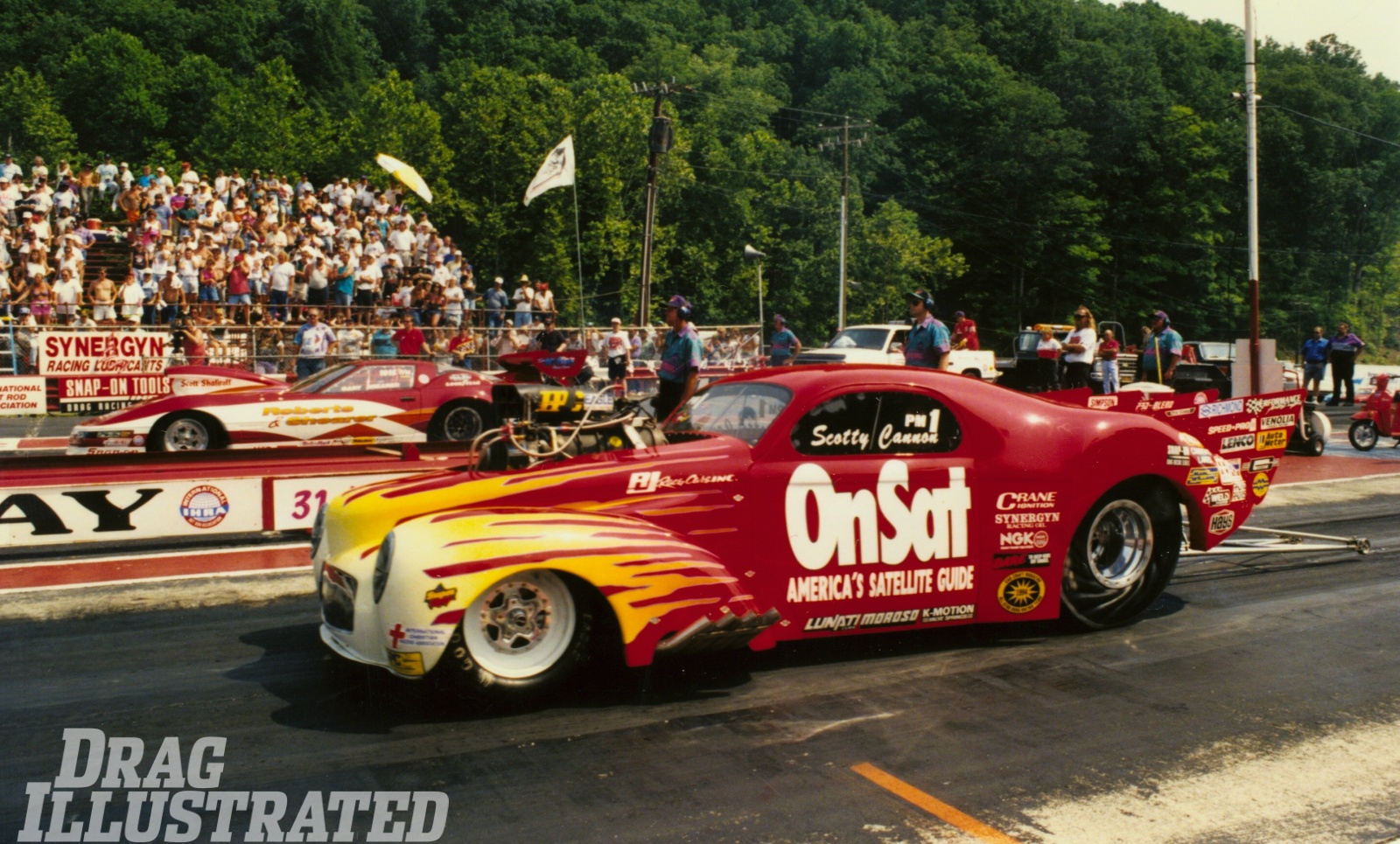
You mentioned the rule changes and the controversies. Did that ever create any trouble in the pits for you?
I wasn’t used to having the rules changed on me and I never did like it and sometimes it would mean some guys would be laughing at me if I struggled for a race or two, but mostly it was just bickering between Tommy (Mauney), Gene Fulton, me, Shannon Jenkins, Carl Moyer, your normal racing bunch. We just stayed at each other’s throats 24-7. There were arguments and occasional confrontations, but when I pulled up to the race track, Shannon never had to worry about me walking over and punching him out and I never worried about him doing that to me.
I’ll never forget one time in Epping, New Hampshire, and I had set one end of a world record, but I’d used up all the fire bottles and was trying to borrow them from anybody, even the Funny Car guys, and they (IHRA) came over to me and said if I’d used up all the fire bottles they weren’t going to let me run again.
So I said I just won’t blow up anymore and I’ll let off at 12-hundred feet. They said you already do that and I said no I don’t; I only do that if I know it’s going to blow up. So the next run, I reached in the car and changed timing and took a bunch of compression out of it, but once I got going I wasn’t paying attention and got overwhelmed with how good the weather was and that next run I ran it to the end and it set both ends of the world record and I won the race. Well, somebody had took a bag of peanuts (considered unlucky in racing) and strung them from the front door of my trailer that night. It had to be about 4:00 in the morning because we worked until 3:30 fixing motors, and they thought that was funny. I got mouthy with a bunch of them that time.
But looking back now, that’s part of what made it fun back then; that’s all gone now. It’s dying. And a year or two ago I would have agreed that it’s probably good, but now I don’t.
What do you mean?
The reason why is because looking back on the whole picture, and it’s easier to be judgmental about history, me and those nitrous guys had to fight it out. If I hadn’t of went blown, would ADRL even be here today? I don’t know. If Walter Henry had not come out with that lock-up clutch and all that Funny Car stuff in his car before he got killed, would we be where we’re at? I don’t think so. If Oddy didn’t come out with that solid-mounted car and just stomped everybody’s butt back in the early ‘90s, would we be where we’re at? I don’t think so.
The controversy and the difference in the class that everybody else seems to try to take out of it—and by everybody I mean rule makers and organizations—that’s what makes things interesting. When a person tries to create a class and tailor it to one specific combination, that’s okay if you just want to create a playground to play in, but that’s not the smartest thing. Even in ADRL now, there’s not any rivalry.
Here’s what happened; if you take someone like me, that’s going to be opinionated and still going to give 110 percent, a sponsor sometimes is still a little leery because they don’t know which way it’s going to go, so the nice guy thing seems to work. Well, Hulk Hogan isn’t a nice guy, but he’s filthy rich.
So what should be done to promote rivalries?
Well, I was in on some of the NHRA meetings and they actually said we need more ‘enthusiasm,’ as they called it, and more energy in my interviews. I said I don’t know what you mean by ‘enthusiasm;’ if I get out and piss in the wind, is everybody going to like that or just call me stupid?
You’ve got to admit one thing. I still to this day, even though I don’t run Funny Cars or dragsters, the one thing that I did that people who don’t know anything about drag racing still remember is when Oakley used me to challenge John (Force) for a big race when I first came over, and he knew all about what we were doing.
I don’t know how much money (Oakley) made off it and don’t care; I’m glad they did well. But they told me more than once they did very well. And Jim Jannard and I are still real good friends, always will be. To make a long story short, where’s that kind of stuff now? Name anybody, even when their car’s running good, that would challenge John. Him and John don’t need to be hugging; he needs to be kicking John’s ass in the eyes of the public. And when John’s kicking it, he needs to be the old John that John used to be. Everybody bring it on, that’s what he used to tell them.
Or how about me and Whit Bazemore in Atlanta? There was never a punch thrown; we were teammates; all it was was words, his words and my words, but we covered the TV screen. They kept us on that and the big screen at the track. He mouthed off and I mouthed off, and it kept brewing from a few days before.
But truthfully? Whit Bazemore is one of the nicest guys you’ll ever meet; you’ll not meet a better person. A lot of the fans, they want to paint Whit as some kind of candy ass, but you’ve got to be kidding me! He’s no candy ass. He was ready to step up to the plate and go toe to toe with me. I was dumb enough to try and he was smart enough to lock the doors on the car. But it sold a shitload of Oakley stuff at that event, as I remember. A few more incidents like that and we would have had to get another merchandise trailer. But all that is gone. It’s not there anymore, in no class, in no series.

But can those kinds of incidents be promoted without it getting out of control?
There was never any harm done. I never hurt anyone, I never touched anyone. Nobody’s going to do that. It’s not the way to settle things. But aggressively expressing your opinion, there’s nothing wrong with that. Look at professional wrestlers; all they do is run their damn mouths and make millions. We didn’t do that on purpose, but it worked for us, too.
I don’t care; if you take one driver that doesn’t have charisma and a driver that does have it, if you’re trying to create it you can’t make it happen. If you take that guy who has it already, you can calm him down to where if you tell him to shut up, if he’s smart, he’ll shut up. You can’t make actors out of drag racers because we’re hard-working and passionate people.
There were more than just me out there before, too. We had a lot of guys that were what I call real visual racers. Jim Oddy was one of them. He’d stand there with his car and the friction was there, the air you could cut it with a knife. But that was good. Looking back on it, that was good. It’ll come back, somewhere, somehow.
Right now it’s fading away and not because of IHRA or ADRL, but because we let it happen. People have let it drift away a little bit. And the money; the more money that gets in it, the more politically correct it becomes, but it doesn’t have to be that way. Yes, you have to be respectful, and yes, you have to know who the boss is and know when to sit down and shut up and know what to say. But you don’t have to walk around scared. And I hate to say it, but drag racing has got 90 percent of its racers scared. You have to let the stars be stars.
What was it like being one of the first U.S. Pro Mod drivers to compete in Australia?
For years, all I heard was you couldn’t go down there and outrun them Australians, and I was like, bullshit! I had never met (Top Doorslammer champ) Victor Bray or even talked to him, but they built me a car and I used his motor and most of his parts, but I took my own blower. It was a Roots blower versus a screw, which was unheard of and everybody was laughing at me and saying I was going to get my ass kicked.
Now he was running a whole bunch of speed, but he wasn’t running ET, and what he failed to understand was they didn’t make the rules for what I was bringing. So instead of me taking a 60-degree rotor, he found out when I got there that I had Mert make me a special 16:71 high-helix that I’d never run before.
Well, the second pass on the car that thing went like a 6.36 and the best he’d ever been was a .32—and I’d left at idle just to get my license. He said we’re in trouble, and I said no we’re not; you are! And all over Australia, that was it.
Understand, I would eat, work and sleep with this guy over there. We drank whiskey together at night; we celebrated and were best of friends. But when I got in the car, Victor Bray became my worst enemy. He couldn’t stand me and I couldn’t stand him. And you know what? That made the whole show. They sold out almost every ticket at every race we went to.
Going to Australia also introduced you to Murray Anderson and his swing-arm rear suspension, right?
Yeah. Naturally they had it over there; he built it for Victor first and I guess all the cars there had them. It’s a big, long ladder bar, basically; it’s a little higher but not much. I wasn’t sure about it but they told me not to worry, the car goes straight, and Murray was there at every race. He never really told me what to do, but I watched him. He said this is really hard for me, to make your car run, and a tenth or two-tenths faster than Victor, and he’s my main customer.
Oddy actually had someone here that designed something similar a couple or three years before I went. Mine was a new design, the first long one. Murray told me that and I told him to do what he wanted. He said no other car is like this, yours is going to be different than Victor’s, but I know what to do and you’ve got to trust me. The first three or four runs it wouldn’t go down the track.
Were you feeling pretty concerned at that point?
I wasn’t concerned; I was so mad and disappointed that I was ready to shoot myself. I couldn’t go two feet. But we tried a few things and finally got it figured out the day I got my license down there, right before we had to go race for real.

It must have worked pretty well, since you bought and brought that Anderson-built Studebaker back to the States with you.
Yeah, I had mentioned I’d like to run it at home because when I was over there they had changed the rules at home from a straight-rotor blower to a 32-over high helix. And I had run a high-helix there and knew they had more power. I said to someone, if I had this car back home I could smoke those guys so bad they’d think the ‘90s had started all over again. Knock on wood, they passed the rule before I came home and I made sure I got the car.
The government down there actually helped Victor pay for that car in some roundabout way and when I went to buy the car from him I was allowed to pay just what money he had in it. And their dollar was a lot less than ours at the time so I only gave $30,000 for that car. That was without motor and transmission. Victor took all his personal stuff off.
So I only got the car seven days before the first race that year (1998) at Bradenton (Florida), but I had them ship me the doors ahead of time and I made some lightweight doors because the car was way too heavy. They run real heavy over there, like 2700, 2800 pounds, but we could run 2500 and I eventually ended up making it a whole new body.
But at Bradenton both doors flew off the very first qualifying pass. That wasn’t too good. I let off it at a thousand feet and the only reason I let off was because I was scared; the doors were off, but the car was hauling ass. It went number one. I won that one and went on to win the championship that year. I’m the only one I know of at that time to win a championship with a foreign-built car. In IHRA I know I was for sure.

How are you feeling these days?
I don’t really have any health problems; my blood work is 100 percent every year. I have reading glasses, if that counts.
The one main problem that I’ve had is with my back, but it’s the best it’s been in years now. I’m not making excuses, but I never really had much trouble with my back in the ‘90s. It hurt some, but not severe, but I did rupture it in ’97 before I went to Australia, in the last (IHRA) race that year. I qualified, but I didn’t get to stay and race the next day and I had surgery three days later. Four weeks later I was in Australia. I never went back to the doctor. I came back and went straight into IHRA racing, won the ’98 championship and went straight into the Funny Car that winter. So I never did let it heal, they say.
In ’06, I ruptured it again. I broke it in the Top Fuel car in Rockingham on the top end. They’ve got skid plates on those cars and the seat belts were tied down over my shoulders and were pulling my spine down when the car bottomed out. I knew that, but that was a brand new car and it was the first time we ran it. We were going to move the bar up later and just didn’t have time. That cost me an operation, but I had three weeks before the next race so they did emergency surgery on me two days later and I was back driving again.
This last time I had surgery, the same one, just a ruptured disc, they had to dig all the scar tissue out and operate on me with no trauma, meaning if you ever ruptured your back and let it slide for six, seven, eight weeks, whatever it takes, it’s not infected or inflamed. There’s no trauma around the wound. What he fixed this time, the doctor said this is the best operation you’ve had. He said if you’d just give me six weeks of nothing much at all and six months of light duty, no race cars, you’re going to see a difference. And he was right.
It takes a year, by law or science, for your back to heal from surgery. It’ll let you get up and move around, but it really takes a year for it to heal; it’s the slowest healing thing on your body. But it feels great now. Either that or I’m just used to it.

What would be your ideal job in racing now?
Everybody says, well, what do you want to do now? My cat’s meow right now would be to crew chief for a team, it doesn’t matter who drives. I would like to fool with the turbos some because I can see the turbo era in the era I was in back then. I think I could apply myself, especially down at the race track with some of the cars and the stuff I see. I’ve got to be smarter than I was back then; I think I could apply it and make it happen.
The good thing about the turbo stuff is they have the power; they’re just having trouble maintaining it and managing it. Well brother, I’ve raced 54 races in one year. I’ve been up and down dirt roads, racing. Raised a family on it, so getting down the tracks was one of the key objects once I went to a blower. When I would match race, I could put a high helix on it and the power was unlimited for what I needed; it wasn’t even a question. But going down the track was a horse of a different color; it was all in the clutch set-up. I actually ran an automatic a little bit back then, too, but the converters and the input shafts wouldn’t stay in the car.
Are you not interested in getting back behind the wheel?
I’m interested in whatever. I wouldn’t expect an outrageous price to drive, but if somebody came along right now, I would sure try. If there was enough money to run the car, the door is open for anything. I’m only 49, so I do hope I have that opportunity again. My wish in the world right now is that somebody would read this article and call me and say, ‘Hey, let’s see how it goes, see what happens.’
I’m game because I’m healthy enough to try. But if I felt myself going downhill, before I wound up in the hospital, ruptured again, I’m old enough now to say hey, I need to get out of this or whatever—but I really don’t think that would happen.
What are you most proud of in your career?
Just being a part of Pro Mod when it started from scratch, the roots of it with Oddy and Quain and Bill Kuhlmann and Blake Wiggins and Tommy Mauney and all those guys. And I’m proud of the time I spent with the fans. I spent as much or more time than anybody talking to the fans, talking to kids.
When I look back, do I remember what races were the best? Not really. They were all equal to me. What championship? My first one and the ones I got after I lost in the ‘90s, they were probably my most gloriful because I was on the pedestal for four years in a row and I got beaten off it. Not bad, but I still fell off. You go from the top to the bottom, I don’t care if it’s a number one or a two on your car; it makes a difference.
And just racing and enjoying myself, I just love it. I drove a Top Fuel dragster and a Funny Car, but the Pro Mod doorslammer, that’s my passion for sure. Just racing, I love it. It’s all good.
The post DI Classic: Scotty Cannon’s Drag Illustrated Interview first appeared on Drag Illustrated.