Only a month removed from the conclusion of the Drag Illustrated Winter Series presented by J&A Service – which produced arguably the most competitive Pro Mod drag racing in the history of the sport – the class finds itself in the middle of a heated, public, and deeply personal debate over parity between its dueling supercharger combinations.
The numbers from the Winter Series tell the story of just how tight the racing has become. At the Snowbird Outlaw Nationals, the spread from No. 1 qualifier to No. 32 was just .055 seconds. At the U.S. Street Nationals, that number tightened to .041. And at the seventh running of the World Series of Pro Mod, the biggest and richest Pro Mod race in the history of the sport, the 32-car qualified field was separated by a razor-thin .049 seconds.
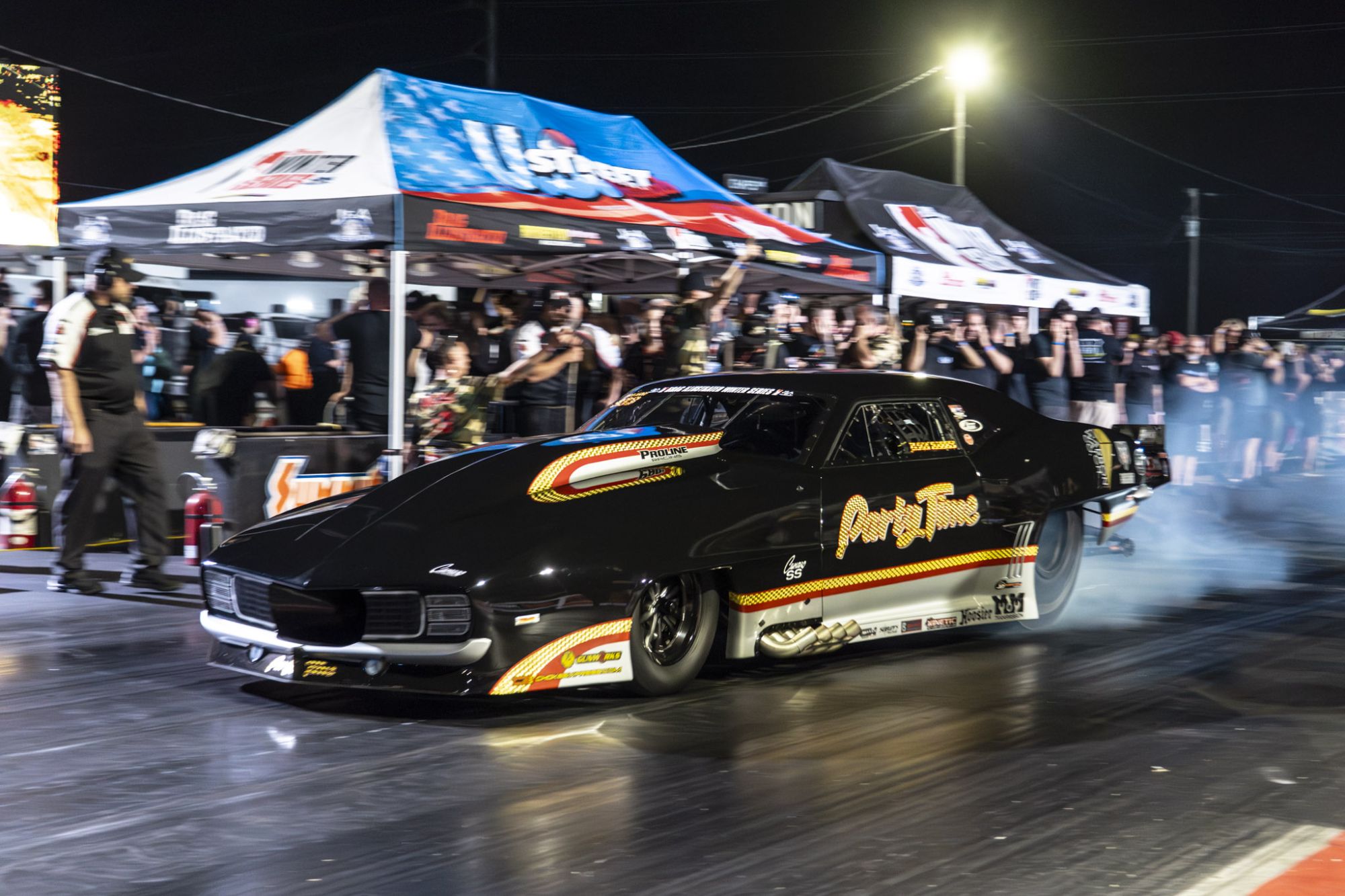
Centrifugal supercharger-equipped entries won two of the three Winter Series races – Jason Harris ran the table at the Snowbird Outlaw Nationals, going 3.561 at 211.06 mph in the final round to beat Sidnei Frigo’s screw-blown, KTR-tuned entry and claim the $50,000 Pro Mod victory in his Harts Charger-equipped “Party Time” Harold Denton tribute ’69 Camaro, tuned by Brandon Stroud. Aaron Stanfield captured the $150,000 World Series of Pro Mod title, bookending the series with centrifugal victories. Steve Jackson’s screw-blown KTR Shadow 3.0 ’68 Camaro took the U.S. Street Nationals in between – going 3.566 at 210.80 in the final after his opponent, Derek Menholt, went red by six thousandths on a 3.570 – but the overall trend was clear in a category that has historically been dominated by screw blower cars: the competitive landscape is changing, and it’s changing fast.
What made the USSN field particularly staggering: all 32 qualifiers ran in the 3.50s – the quickest qualified field in Pro Mod history. And at the World Series, Stanfield’s story was as unlikely as it was compelling – making his Pro Mod debut during the Winter Series in December, Stanfield drove a screw-blown Elite Motorsports Camaro at the first two races before switching to a Harts Charger centrifugal ’69 Camaro out of the Scott Tidwell Racing camp for the WSOPM. He qualified eighth and beat Peter Norton – who won the 2025-26 DI Winter Series championship in the Harts Charger-equipped Hurricane Motorsports ’69 Camaro, tuned by standout crew chief Rickie Jones – in the final by just .003 seconds. Norton, a tractor pulling veteran who bought his Pro Mod car from Jeff Rudolf last November, earned Rookie of the Year honors and came out of nowhere to establish himself as one of the class’s most exciting new characters.

All Eyes on the Rulemakers
All eyes had been on drag racing’s multiple Pro Mod sanctions and series following the conclusion of the Winter Series. The PDRA made headlines when they announced their 2026 rules package prior to the start of their season, generating considerable conversation online. But the temperature rose significantly in recent days after both the PDRA and IHRA made parity-driven weight adjustments following their first races of the 2026 season – both moving weight onto centrifugal cars and taking weight off screw blower entries.
It’s worth noting that the conversation around parity was already well underway before either sanctioning body made its move. During the Winter Series, officials made a controversial mid-series adjustment ahead of the World Series of Pro Mod, adding weight to the centrifugal combination after Eric Gustafson’s ProCharger-equipped Coast Packing Co. “Lard Machine” ’69 Camaro set a Winter Series record of 3.543 at 211.30 mph at the U.S. Street Nationals. Despite considerable online scrutiny, Gustafson and tuner Jason Lee still managed to qualify the car No. 1 at the World Series of Pro Mod with a 3.553 at 211.16 – and looked like a clear favorite to win based on the car’s consistency and performance.
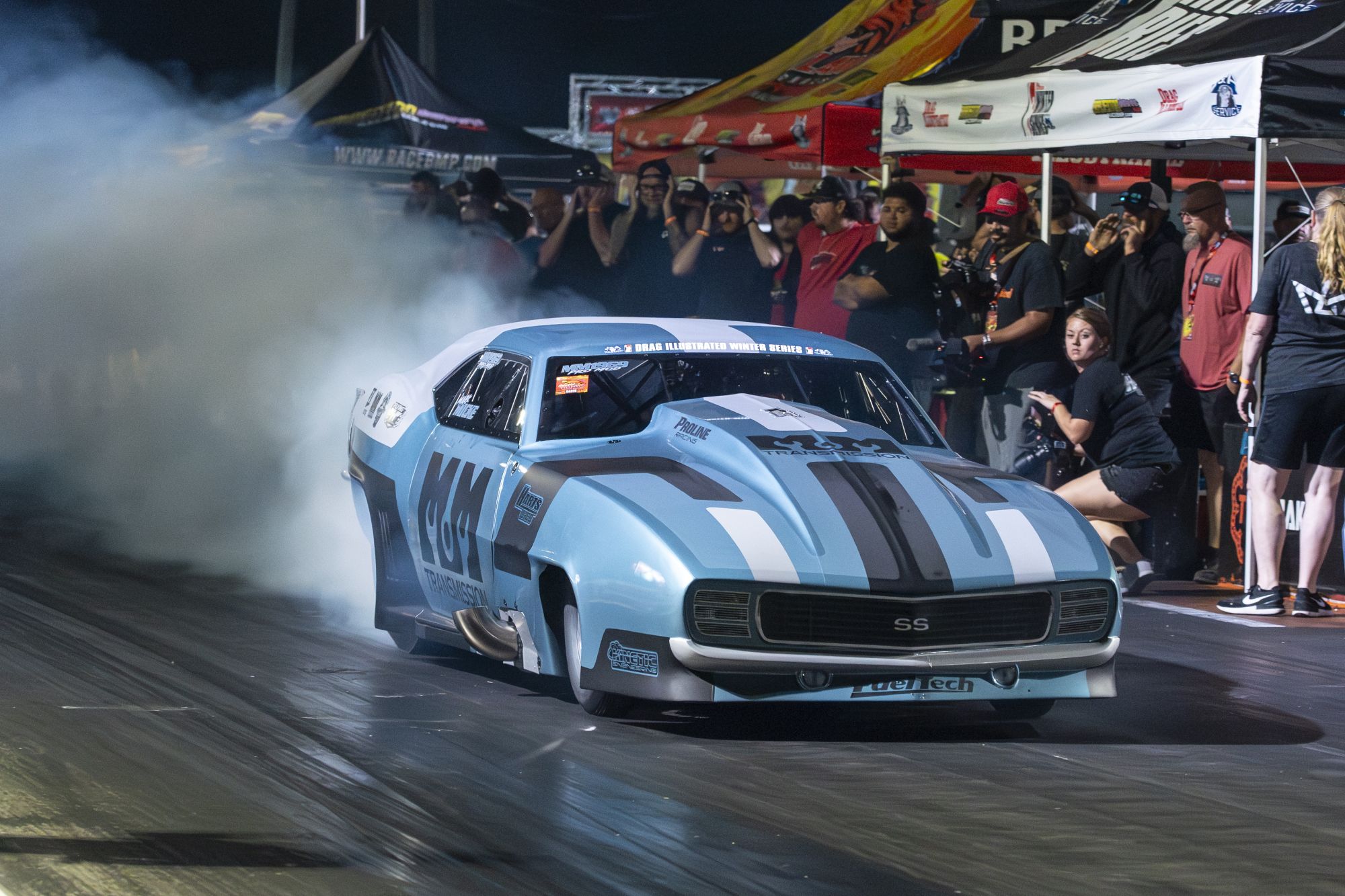
Now, as Pro Mod’s best go their separate ways to compete in their various series across the country, a growing sample size of races is creating a tremendous amount of conversation around the parity question – and the racers themselves are doing the talking.
The Conversation Goes Public
Bob Harris – a longtime drag racing figure, former track operator, original president of the PDRA, and father of Pro Mod superstar Jason Harris – posted a detailed breakdown on Facebook in reference to rumblings throughout the community that Pro Mod sanctions were considering rule changes to address a perceived performance advantage by centrifugal supercharger entries over screw-type superchargers. Harris cited historical performance data, including screw blower national records, and argued that the numbers didn’t support the narrative that centrifugal cars were running away from the field. It’s worth noting that his son Jason – who won the Winter Series-opening Snowbird Outlaw Nationals presented by Motion Raceworks, was the only driver eligible for the Elite Motorsports $1 million bonus for winning all three Winter Series races, and is a two-time PDRA Pro Boost champion – is firmly established as one of the centrifugal camp’s biggest stars.
The response was immediate – and pointed.
Kurt Steding, the P2 Contracting ’69 Camaro driver and 2024 PDRA Pro Boost championship runner-up, fired back directly at Harris: “I love your son, but stop please. You guys run 65 pounds of boost and we run 45-46.” Steding went on to detail the physical toll the screw blower combination takes on hardware, noting that his team went through four motors during the Winter Series alone, and drew a sharp contrast with what he sees as a far less demanding maintenance schedule for centrifugal teams.

Billy Stocklin, a veteran tuner with decades of experience across multiple power adder combinations, offered perhaps the most widely shared line of the entire debate: “Screws haven’t changed since 1983. Run a 1983 centrifugal and then we can talk.” The comment drew over 60 reactions – the most engagement of any single comment in the thread.
Reigning PDRA Pro Boost world champion Ty Tutterow weighed in publicly as well, and PDRA Pro Boost front-runner Randy Weatherford responded by telling screw blower teams to “get your ass to work.” The exchange between two of the PDRA’s biggest stars fueled days of back-and-forth online.
Mark Savage – a protege of legendary Pro Mod racer, tuner, and supercharger specialist Al Billes, a DI 30 Under 30 alum, and one of the most renowned independent tuners for hire in the country – took to his own Facebook page to post about what he sarcastically dubbed “Flat Hoods R Us” and “Elite Promod” – references to the centrifugal cars’ flat-hood appearance compared to the visually iconic blower hat of a screw car. Savage, who is part of the Al-Anabi Racing camp and worked alongside Todd Tutterow in 2025 to lead driver J.R. Gray to the NHRA Pro Mod world championship, challenged the centrifugal camp directly on boost numbers, writing, “How many pounds of boost have the Harts/ProCharger picked up since these days you speak of? I already know the answer – just want to see if you’ll publicly admit it.”
Several of these figures – including Dewayne Mills, father and crew chief on rising screw blower star Kallee Mills’ ’68 Camaro, which is tuned by standout Pro Mod tuner Lee White – have historically maintained a relatively quiet social media presence but have entered the conversation as the stakes have risen. White, too, has weighed in on the debate publicly.
A Debate as Old as the Class Itself
For those who have followed Pro Mod since its inception, the parity debate is nothing new. Rule controversy has been part of the class’s DNA since the first time a second power adder combination showed up to race against the first one. The early days featured nitrous versus supercharger arguments. Then it was roots blowers versus screw blowers. Then came turbos. And now, the conversation has evolved to supercharger versus supercharger – specifically, screw-type blowers versus the centrifugal units produced by ProCharger and the newer Harts Charger platform.
“Pro Mod thrives on this kind of controversy, and it’s what has always made the class so unique,” DI co-host Mike Carpenter said on this week’s edition of The Wes Buck Show. “This is maybe one of the first times we’re seeing a combination that can compete with the screw blower. And now those guys find themselves in a different position than they’ve probably ever been.”
The mechanics of the debate center on a fundamental regulatory asymmetry: screw blower cars are limited to a 92% maximum overdrive in most eighth-mile series, which directly caps how fast the blower can spin relative to the engine. Centrifugal cars, by contrast, are regulated primarily by head unit size – the physical dimensions of the compressor – and by minimum weight. The screw camp’s central complaint is that while their primary performance lever is hard-capped by overdrive, the centrifugal camp has significantly more room to tune within the rules.
The result, according to screw blower advocates, is a significant gap in available power – one that weight adjustments alone may not be able to close. Multiple well-placed sources from both sides of the debate confirm that the boost numbers between the two combinations are not close, with screw blowers producing roughly 45-46 psi and centrifugal units making substantially more. Centrifugal critics argue the gap has only widened in recent months as competition between ProCharger and the newer Harts Charger platform has accelerated development on both sides. Meanwhile, screw blowers – which are SFI-certified, sealed units that cannot be modified – have seen no corresponding leap in available technology.
The Stakes Have Never Been Higher
Perhaps what’s most notable about this moment in Pro Mod isn’t the disagreement itself – it’s the volume, the visibility, and the passion behind it. For years, rules conversations in Pro Mod happened behind closed doors: late-night phone calls between racers and series officials, PRI Show hallway debates, private group texts. What’s happening now is fundamentally different. The conversation has moved to the public square, and fans are watching, engaging, and choosing sides in real time.
That matters.
“In the past, I would have argued that maybe we should shy away from openly discussing rule controversy,” DI Founder and Editorial Director Wes Buck said on The Wes Buck Show this week. “But the more I’ve watched this develop, it’s like – no. This is something we have to lean into. This drives conversation. This drives engagement. It gets people talking and gives them an opportunity to choose sides.”
It’s also worth noting that despite the conversation being framed as “screw vs. centrifugal,” the Winter Series told a more complicated story than a simple runaway. Jackson’s USSN win was dominant – he beat Gustafson on a holeshot in the semifinals, going 3.602 to Gustafson’s 3.591. The KTR camp had a car in the final at three consecutive Winter Series races. Harris’s Million bid ended in Round 2 at USSN when he suffered a mechanical failure against Menholt. And the screw camp’s best cars – when the combination is treated right – are clearly still capable of winning any given weekend.
Nobody’s going this crazy on social media about the rules in hardly any other class of drag racing. That says something about Pro Mod’s place in the sport – and its future. The fact that eighth-mile Pro Mod rules are making headlines and driving drag racing conversation on social media is, when viewed through the lens of what it means for the class, undoubtedly a positive thing.
The next PDRA race will carry infinitely more juice because of this. So will the next IHRA event. Every qualifying sheet will be scrutinized. Every head-to-head matchup between a centrifugal car and a screw car will carry added weight. And every rules decision – or non-decision – by every sanctioning body will be dissected by a fan base that is more engaged in this conversation than it has ever been.
The stakes in Pro Mod are rising. The conversation has never been louder. And the racing has never been closer.
Stay tuned. This is far from over.
This story was originally published on April 4, 2026. 
The post Pro Mod Team Owners, Crew Chiefs & Drivers Spar on Social Media Over Parity, Rule Changes first appeared on Drag Illustrated.