For as long as I’ve had a front-row seat to this sport – for as long as I’ve watched drag racing try to claw its way into the modern attention economy with one hand tied behind its back – I’ve been saying the same thing like a broken record: we don’t have a racing problem. We have a storytelling problem.
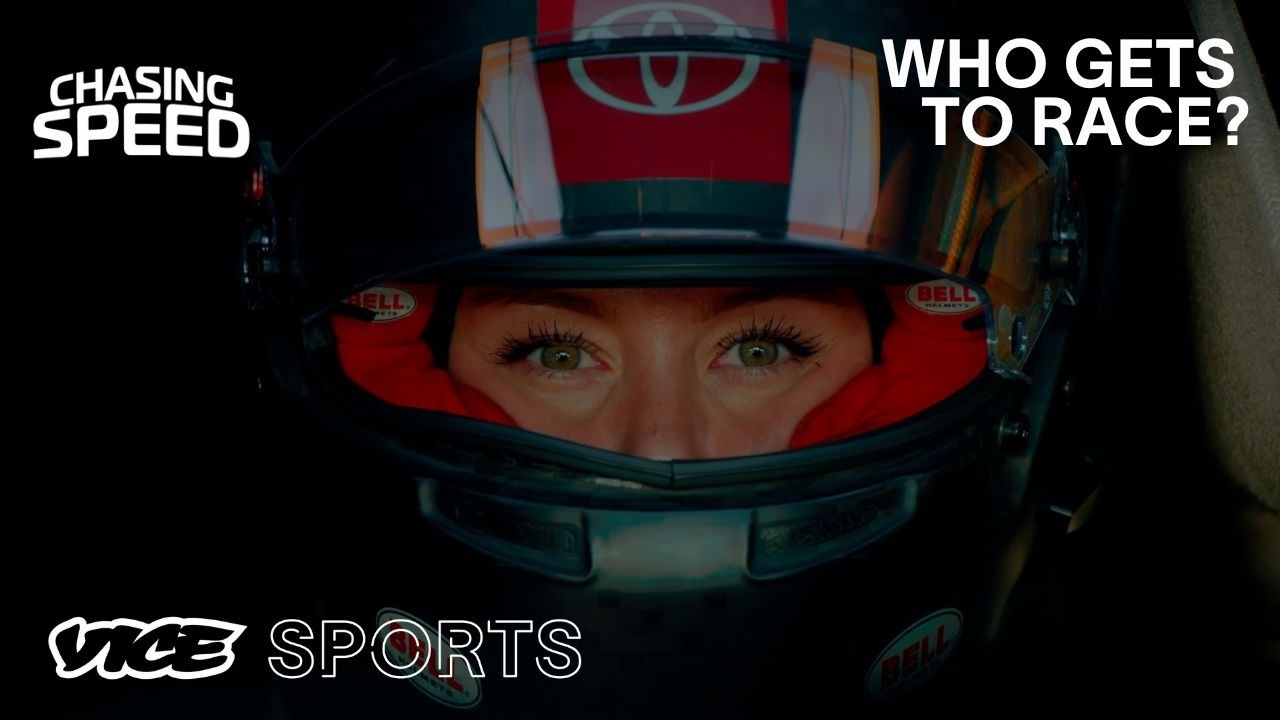
And that’s why this new VICE Sports-produced NHRA docuseries, Chasing Speed, matters.
Not because it’s “cool.” Not because it has slick camera work and cinematic pacing (it does). Not because it’s a nice little victory lap heading into NHRA’s 75th anniversary (it is). It matters because it represents a philosophical shift – one that NHRA should’ve made a long, long time ago – from treating drag racing like a mechanical exhibition to treating it like what it really is: a violent, beautiful, human drama played out at 330-plus miles per hour.
Here’s the truth nobody can outrun: the cars will bring you out once.
The speed. The sound. The way it rattles your ribcage and makes you laugh like a kid the first time you feel a nitro car hit you in the chest. The sensory overload – the smells, the chaos, the spectacle, the competition – it’s intoxicating. Drag racing is still the most primal motorsport on Earth.
But if we’re being honest, the cars aren’t what bring people back over and over again.
People come back for people.
They come back because they saw a driver they connected with. A tuner who looks like a mad scientist and talks like a street poet. A family operation thrashing under a pop-up tent like their whole world depends on the next round. A champion who’s somehow still insecure, still chasing, still haunted by the idea that it can all disappear in one blink.
That’s the gateway drug. That’s what turns a casual viewer into a real fan – the kind of fan who buys tickets, wears the merch, watches the live stream, argues in group chats, and plans their weekends around your schedule.
And drag racing, historically, has been hesitant – sometimes stubbornly so – to fully embrace that.
NHRA’s own DNA tells you why. Wally Parks didn’t build NHRA to create celebrities. He built it to create order. He used Hot Rod magazine as the megaphone, he tried to “create order from chaos,” he wanted safety, standards, legitimacy – and the organization he founded absolutely succeeded at that.
But somewhere along the way, that mission hardened into a worldview. A belief system. And one of the most famous expressions of that belief was essentially: the cars are the stars.
I understand where that came from. In the early days, the innovation was the hook. The machinery was the magic. The engineering arms race was the story.
But in the context of mass culture – in the context of growing a sport into something that can compete for mindshare – that mindset is a ceiling. Maybe even a deathknell.
Because NASCAR didn’t take that fork in the road.
NASCAR sold characters. Outlaws. Rebels. Moonshiners. Feuds. Heroes. Villains. It sold the people first and let the machines be the amplifier.
Drag racing, too often, sold horsepower first and hoped the people would matter later.
And guess what? The people who broke through anyway – the biggest icons this sport has ever produced – didn’t wait for permission. They didn’t wait for the sanctioning body to “introduce” them to America. They built their own gravity.
“Big Daddy” Don Garlits. Shirley “Cha Cha” Muldowney. Don “The Snake” Prudhomme. John Force.
They created storylines around themselves. They understood, intuitively, what modern sports media now treats like gospel: if the audience knows you, they care. If they care, they watch. If they watch, they buy. If they buy, the whole ecosystem rises.
That’s why Chasing Speed feels like a landmark. Because it’s NHRA finally playing the game on the right level.
The premise is simple: six episodes, VICE Sports production, NHRA partnership, built around the 2025 season, positioned as a high-stakes inside look at the culture, the danger, and the personalities that make the whole thing go.
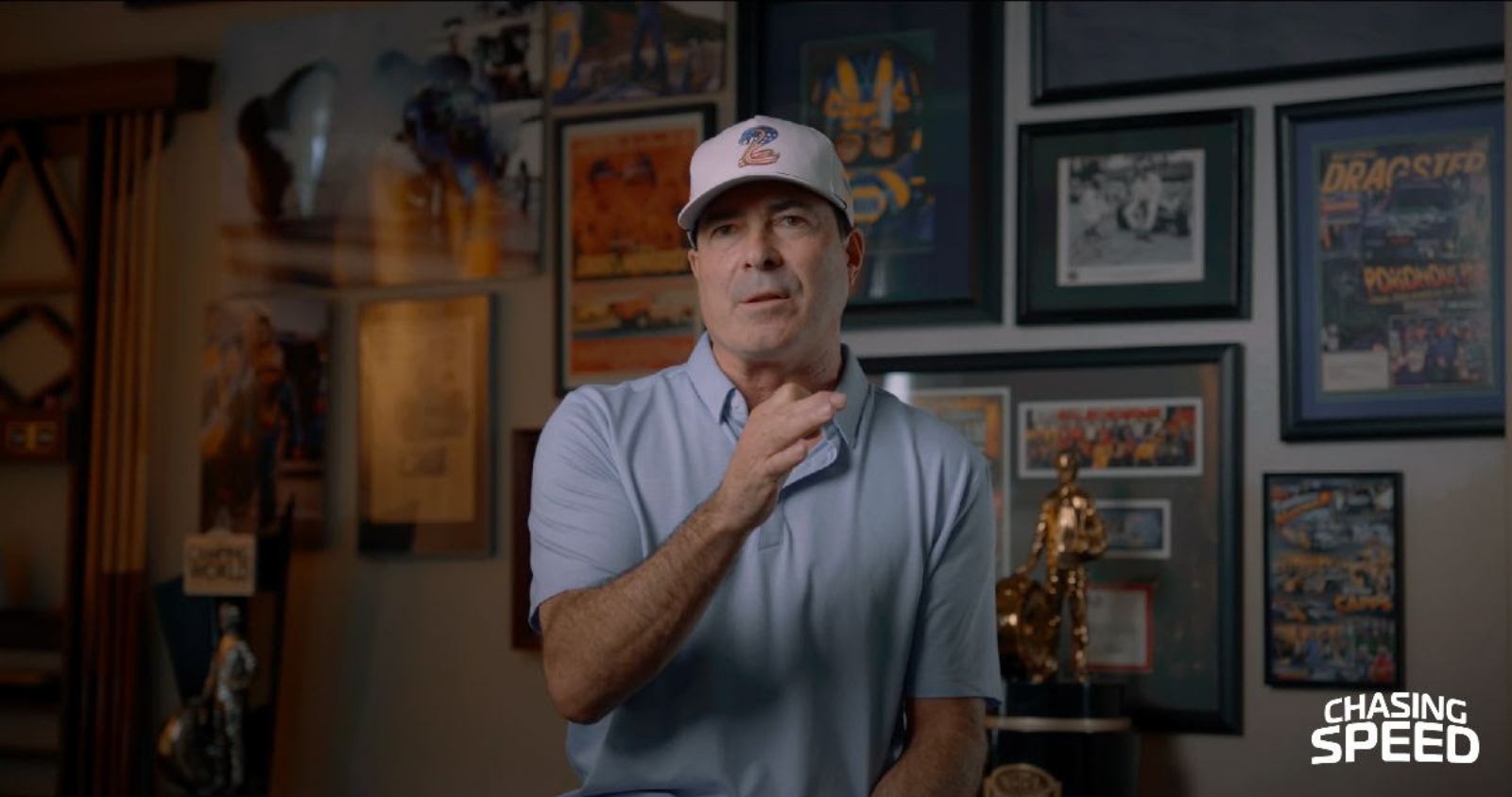
And crucially: it’s not shot like a press release. It’s shot like a real docuseries. It looks like something you could recommend to a normal sports fan – not just a card-carrying drag racing lifer.
That’s the difference between “content” and “conversion.”
If you want to understand why this matters, look at the modern blueprint.
The UFC was not always the UFC. There was a moment – a real moment – where they needed a cultural bridge. Something that would turn violence in a cage into a product people could emotionally invest in. And they found it in reality TV. ESPN has reported that by 2004 the Fertittas had put more than $40 million into the UFC, and the company still needed a breakthrough; “The Ultimate Fighter” was the swing.
And once people started knowing the fighters – living with them, hearing them talk, watching them crack under pressure – the sport became human. The fights weren’t just fights anymore. They were chapters.
Formula 1 had its version too. Drive to Survive didn’t teach America the rulebook. It taught America the personalities. It made team principals into characters. It turned paddock politics into drama. It made people pick sides. Nielsen has measured U.S. fan growth and a halo effect from the series, and ESPN’s own published viewership arc shows F1 climbing from roughly 554,000 average viewers per race in 2018 to about 1.3 million in 2025.
That’s not an accident. That’s storytelling.
So when I watch Chasing Speed, what I see isn’t just a good show. What I see is drag racing finally stepping into the same arena as every other sport that has figured out the new economy.
Because this is the era we’re in now: highlights are everywhere. The on-track product is not enough by itself. The behind-the-scenes product is the multiplier.
And it doesn’t stop at docuseries.
If NHRA keeps walking down this road – if they start thinking like a modern league – the next step isn’t just “make Season 2.” The next step is to build the whole ecosystem around the stories.
Reality/docuseries is the top of the funnel: it creates awareness and emotional buy-in.
Then you expand the surface area.
Toys. The Monster Jam / Hot Wheels lesson is that you don’t just sell an event – you sell an identity that kids can hold in their hands. You create the next generation of fans before they ever have a reason to care about points standings.
Video games. The “stick and ball” sports understand this. They don’t just have fans – they have players. They have kids who learn the athletes’ names because they used them in a game for 300 hours. That’s not a small thing. That’s how you build lifetime familiarity.
And I know what somebody’s going to say: “Yeah, but drag racing is different.”
No it isn’t.
Not in the ways that matter.
Drag racing has everything the modern audience responds to: danger, speed, spectacle, characters, money, pressure, ego, family legacy, rivalry, innovation, heartbreak. It has villains and heroes. It has underdogs and dynasties. It has the kind of blue-collar, high-skill, high-risk authenticity that most mainstream sports wish they still had.
What it’s lacked – from an institutional standpoint – is the commitment to packaging the people as the product.
That’s why I’m giving NHRA real credit here. Not performative credit. Not “good job, guys” credit. I mean legitimate, strategic credit.
Because Chasing Speed is a step in the right direction that’s so obvious it almost hurts. It’s NHRA recognizing that the next phase of growth doesn’t come from shaving another tenth or adding another contingency program – it comes from building stars, building familiarity, and building narrative.
And I’ll say this too: the drivers and teams who participated in this deserve flowers. It’s not easy to let cameras into your world. It’s not easy to be vulnerable in a sport that has trained people to be tough and private. The best docuseries don’t work because the cameras are good. They work because the subjects are brave enough to be real.
That’s how you get new fans.
That’s how you get people to care who wins before they even fully understand why.
So if you’re NHRA – if you’re serious about using this moment – the mandate is simple: don’t treat Chasing Speed like a side project. Treat it like the foundation of the next era.
Clip it. Promote it like your future depends on it. Put it in front of people who don’t already watch. Build the stars. Build the tuners. Build the crew chiefs. Build the storylines you can carry all season long. Let the audience fall in love with the humans.
Because the cars will make them look.
But the people will make them stay.
And for the first time in a long time, it feels like NHRA is finally acting like they know that.
This story was originally published on February 9, 2026. 
The post OP-ED: Chasing Speed and the Moment NHRA Finally Bet on its People first appeared on Drag Illustrated.