John Force’s office inhabits the northwestern corner of the second floor of a sprawling, 60,000 square foot Infiniti car dealership turned race shop in beautiful Yorba Linda, California. It’s a big office, of course, affording a spectacular view of the mountains of Chino Hills Range. Even the empty parking lot below seems impressive from this vantage point, though nothing more than asphalt. It’s difficult to shake the feeling that this is the house that drag racing built. On a recent January morning, Force, looking trim in a white linen dress shirt and a dark blue blazer with Castrol on the right chest, sits in an executive chair behind a massive multi-tiered polished black desk, drumming his fingers. Beautifully framed photographs hang on the wall all around him: His daughter’s baby pictures; John with his wife and daughters at the NHRA awards banquet; professionally taken black-and-white shots of his wife Laurie, as well as daughters Ashley, Courtney and Brittany.
Editor’s Note: This story originally appeared in DI #51 in March of 2011.
Sitting behind a desk, the man born John Harold Force is a bundle of nervous energy, it’s as if he’s hiding something, perhaps keeping a secret he’s dying to tell. He leans forward, looks first to his right, then to his left, seemingly checking to see who all is listening. “You know how much work goes on in here?” asks Force. “None.” His unsettled behavior starts to become a little clearer; Force genuinely isn’t comfortable in this setting – it’s not natural. He stands up, walks out from behind the desk towards a picture window overlooking the lobby, which is literally packed with countless trophies and pieces of racing memorabilia, as well as five complete Nitro Funny Cars – including the mount that carried him to his 15th NHRA world championship just a few months prior. “My office?” he asks. “Try the cab of my Ford F150 pickup truck. A tour of my truck probably wouldn’t be as much fun, though.”
Admittedly, Force is a gypsy. The nomadic lifestyle of the NHRA Full Throttle Drag Racing Series and its 22 national events send him and what he refers to as his “traveling road show” back and forth across the country every season, and has since 1979. Life on the road isn’t anything new to Force, though. The son of a long-haul truck driver, Force inherited his highwaymen genes from his father, Harold. As a kid, Force spent his summers in the bed of a dump truck, riding up and down the California coast through the San Joaquin Valley, picking berries with the rest of his family. “I lived all summer in the bed of a dump truck,” Force says. “We all did. We had our refrigerator in it, we slept in it – people don’t even know.” Suddenly, it’s not that hard to understand why Force is like a cat on a hot tin roof within the confines of an office space, no matter how large or plush. “I’ve got this office here, full of trophies and pictures of my family, my grandbaby, Autumn, everything. I’ve got an office in Indy they built me – state-of-the-art – and it sits right now today empty. I never moved into it.”
Surprising? Not really. Despite having become inarguably the most popular and successful drag racer in history, Force struggles to accept the role, though he can certainly play the part. He’s won championships, set records, defied all odds, time and time again, but for whatever reason refuses to accept the battle as over, the job done, the dream fulfilled. In the world of drag racing, John Force, at the age of 61, certainly isn’t the sole elder statesman; though by and large the majority of racers who have enjoyed continued success in the sport in their senior years have done so by transitioning their careers to team-ownership or some other facet of the industry. Force, in spite of his myriad business ventures, has been enjoying one of the biggest years of his racing career, particularly in the driver’s seat. With his 2010 NHRA Full Throttle Series world championship, his 15th total as a driver, 17th as a team owner, Force’s domination over the sport for more than twenty years is unparalleled in any professional sport.
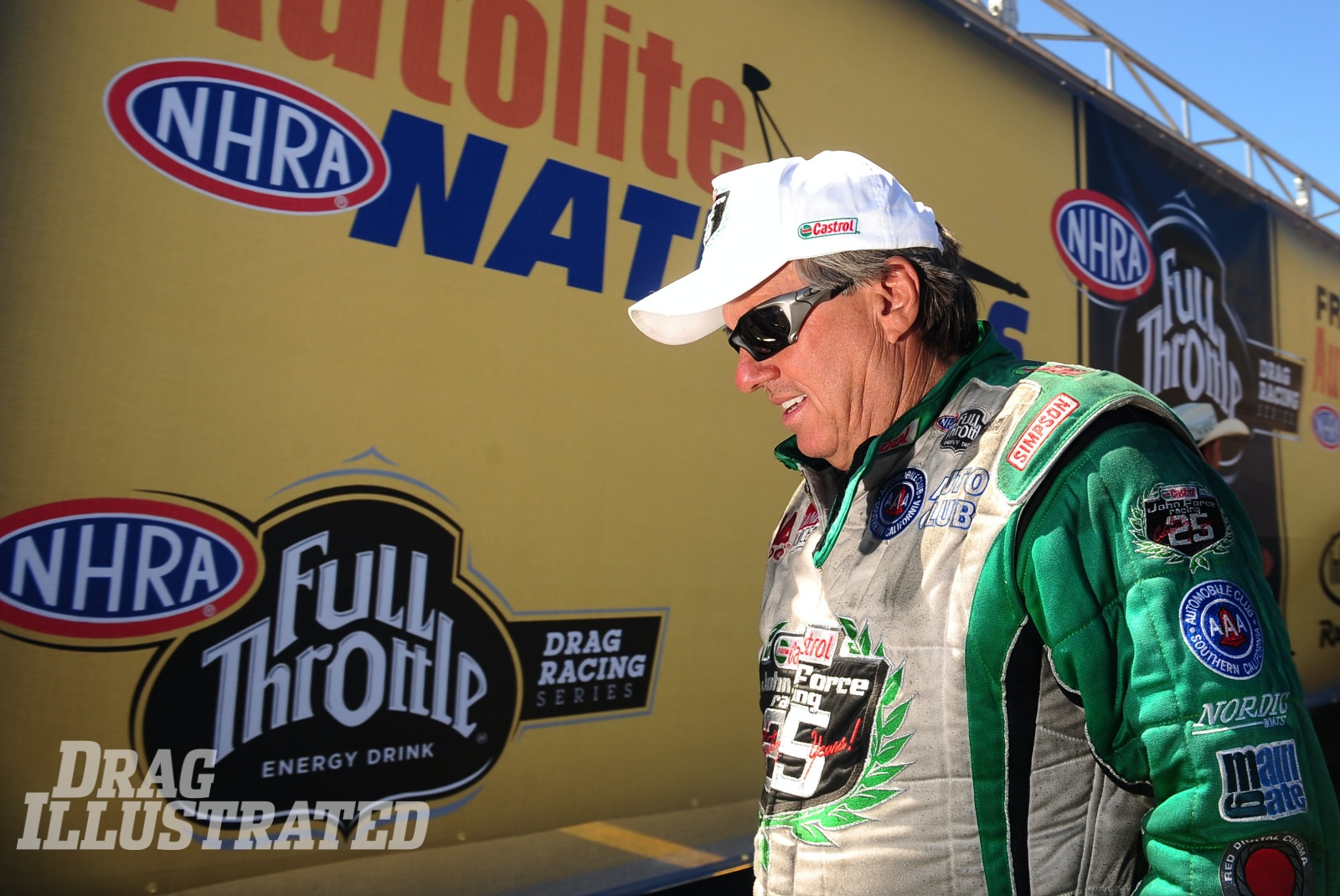
Drawing inspiration from people like Donald Trump and Henry Ford, Force has branched out of the racing industry with various business ventures. He recently broke ground on what will soon be a television studio and production company across the street from his racing facility in Yorba Linda, that already houses a museum and apparel store. “I read once where Donald Trump, he never took vacations,” says Force. “Then he finally took one to some island and he ended up buying a hotel while he was there. It made me laugh because I think the same way. Whether it’s trying to win another championship or build this traveling road show like PT Barnum – I always try to create excitement.”
Though many racers and fans felt Force’s days as a competitive member of the Nitro Funny Car ranks were behind him after a devastating crash in 2007 left him hospitalized with a severely broken left ankle, a deep laceration on his right knee, a fractured and dislocated left wrist, and abrasive injuries to his right hand, he was only down, not out. An emergency six-hour surgery and extensive physical therapy at Baylor University Medical Center in Dallas, Texas, gave Force and family hope that he would walk again, but driving a 300mph race car seemed completely out of the question. Force even had his doubts. “My family was at my side every step of the way,” he says. “They all told me that I’d drive again, and I have to hand it to Robert [Hight] and Ashley – they have that determination.” And drive again he did, but that was about the extent of the experience as the years following the crash were a wash. For the first time in 23 years, Force endured an entire race season without a trip to the winner’s circle in 2009, though Ashley won two races and son-in-law Robert Hight won the championship. The next year, Force returned to his old form and proved that washed up he was not, adding six more wins in 2010 to his resume that already included 126 national event victories.
Tom “The Mongoose” McEwen, a legendary drag racer in his own right, has been a friend of Force’s for years, and was one of the drivers that he aspired to be like in his early days. He says he talked to Force in the months following his accident in 2007, and told him he had to “suck it up” and get back to the track. “A lot of people,” says McEwen, “when they meet John, they think he’s on something – he’s so wound up. You have to know, that’s just John. It’s who he is. When he was down, struggling to qualify, let alone win races, I had to tell him that all he had to do was make the decision. He had to make the decision to win, to get back to kicking their asses like had been. It wasn’t up to anyone else. It was up to him.”

As the tour through the John Force Racing headquarters continues, a young woman enters what is scheduled to be our last stop for the day, the showroom – the third floor of the building, which houses Force’s growing car collection as well as row after row of Funny Car bodies – she’s holding a stack of papers, carrying a concerned look on her face, and glances at her watch briefly before politely pulling Force aside. “Did you eat your breakfast?” she asks him.
“Yes, berries,” Force says. “Good choice.”
The woman, Stephanie Fernandez – Force’s assistant, who he explains helps keep his head on straight – smiles. “I thought you would like them,” she says.
Force, making a point, replies, “She knows I’ll just drink coffee all day if she doesn’t put food right in front of me. I don’t slow down long enough to think about feeding myself.”
Fernandez again checks her watch. “Remember, you have a conference call in a few minutes,” she says. “Or do you want me to try and push it back?”
“Might have to push it back,” says Force with his million-watt smile. “We’re just getting started with the storytelling.”

If John Force happens to stop by any of the local eateries for a bite to eat, maybe take a minute for himself if he dares and run by the theatre to catch a movie – it’s like everyone’s favorite relative is in town – the lady at the theatre wouldn’t dare charge him, waves him on in and calls him by name; the waitress at the restaurant already knows his order. A gypsy, as Force describes himself, is by definition strangers in all lands, but everywhere he goes people know him. Sure, he’s had more TV face time than any drag racer ever, but that’s not the John Force any of these people know.
In public, and on camera, every move Force makes is authentic. He laughs genuinely, smiles often, and doesn’t hesitate to say exactly what’s on his mind. As a youth, Force famously lived with his parents and four siblings in a mobile home at a trailer court in Bell Gardens, California, and spent many a night looking out the window dreaming about the day he’d get out on his own. Though not afraid to talk about his humble beginnings or the success he has achieved in life, Force refuses to fully embrace one or the other. Perhaps it’s that very characteristic that has made him appeal to the masses – his bold and electrifying personality took him out of the trailer park and made him a superstar, while his endearing, lovable demeanor and rags-to-riches story has allowed him to connect with the everyman, and put him in the hearts of millions. John Force’s story makes anything seem possible, and his uncommon ability to tell his story and assume both roles simultaneously has created shoes that will never be filled.
“I come from a family of storytellers,” says Force. “I used to tell stories at truck stops to get a free lunch, and to this day I’m telling those same stories only in a press room. There’s no difference. My momma used to say, ‘Nobody in our family died of cancer, nobody ever really died of a heart attack.’ I’d always ask her, ‘How did they die, momma?’ ‘Well, Johnny,’ she’d say, ‘most of them were hung for telling lies.’ Me, I never lie. I may embellish a good story, but there’s a big difference.”

Widely considered one of the best drivers ever to grace the drag strip, Force’s strongest attributes have little to do with cutting lights or manhandling an 8,000 horsepower hot rod. It’s his ability to connect with people that has served him so well for all these years, though probably not as much to credit for his successes as Force’s never-ending belief that his dreams can, and will, come true.
“Our family is full of very emotional people,” he says. “We believe in the dream. My dad left his family during the depression and hitchhiked to California in the snow – chasing the dream. My momma came from the dust bowl. My family lived The Grapes of Wrath. But we never stopped believing.”
For Force, it would appear the dream has come true. Fame, fortune, and championships – he’s climbed to the top of the mountain. In a list of the Top 50 drivers of all time compiled by the NHRA in 2001 to commemorate their 50th anniversary, Force was named No. 2, second only to “Big Daddy” Don Garlits. Force openly admitted that he would have liked to be number-one; even though that’s a rating he’d never give himself.
“In my mind, I’ll never be better than Don Prudhomme, [Kenny] Bernstein, McEwen,” says Force. “I idolized those guys. That’s who I wanted to be, and I’ll never let myself believe that I’ve surpassed them no matter how many championships we win. It’s never been about championships for me. That’s not what the dream is. If I was to let myself think I was the best, what’s left to accomplish?”
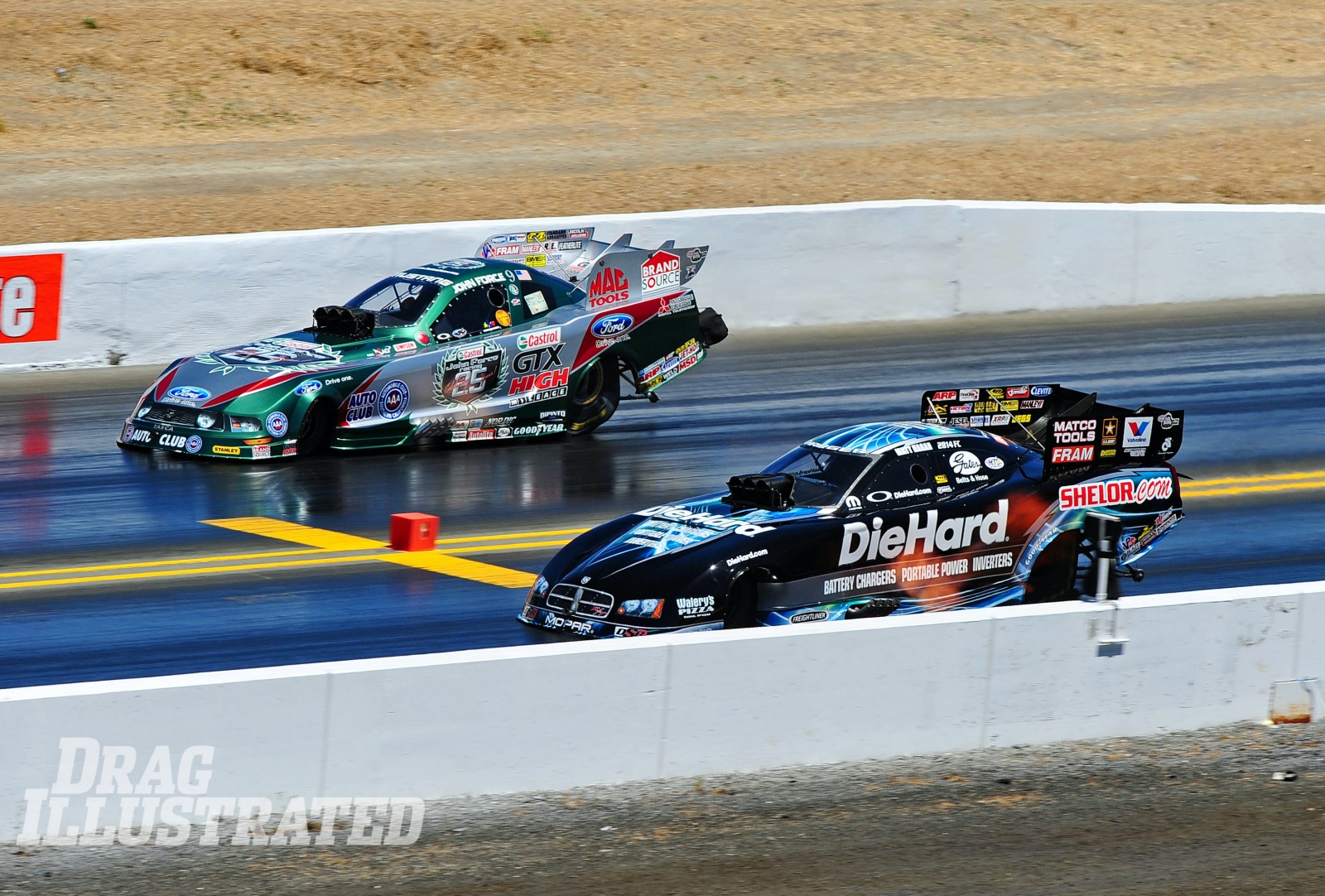
As we exit the showroom, passing by a framed check hanging on the wall from the National Hot Rod Association to John Force Racing for four-hundred-thousand-dollars, Force leads us back downstairs towards the lobby, stopping as we approach a red, white, and blue Automobile Club of Southern California Ford Mustang Nitro Funny Car once driven by the late Eric Medlen – the first of Force’s Next Generation drivers, who passed away in a tragic accident in 2007.
The tale of John Force is defined, like any story, by the actions of the main character when faced with a crossroads. Force identifies two in his life, both involving survival – the first his own, and the second that of those he cares about most.
“I was sitting in my eighteen-wheeler at an interstate truck stop just outside of Memphis,” says Force. “I’d pulled over to call home. My daddy picked up the phone and he told me, ‘John, you have to come home.’ He told me the bank was broke, that I didn’t have any money – it was over. I didn’t know what to do. I remember my head going down on the wheel and I started to cry.
“We didn’t have cell phones in them days. I was parked next to a phone booth and the next day my dad called back. He said, ‘a race track in Houston wants to book ya’. They lost their drivers, Prudhomme and Bernstein, because of a national event rainout, and he said they’ll give you money right now.’ I called the promoter and I asked how much he was paying. He started negotiating with me and I said, ‘Look, I’m either coming or I’m not, but I’m broke – I need a room, I need food for the two people I got with me, and I want half of what you would have paid Prudhomme.’ And he said, ‘You got a deal.’”
Out of gas, figuratively and literally, Force was preparing himself to accept defeat, to quit, and give up the dream. Six hundred miles from a little backwoods track in Texas, Force chose to believe. More than 30 years later, he still is, though that truck stop wouldn’t be the last time his resolve was put to the test. Winning championships, setting records, his daughter set to make her Nitro Funny Car debut, his team growing, John Force was on top of the world. And then he lost Eric.
“I went home and I looked at my trophies, and it made me sick,” Force recalls of the days following Medlen’s death. “What good was any of this without this young kid that was the next generation of John Force Racing? He had helped Ashley, he helped Robert – hell, he was even teaching me. Eric Medlen was really special, and then he was gone.
“All of that glory, all of that wanting to be a hero, wanting to be a star; pounding coffee in the morning, energy drinks through the day, beer every night so you could sleep, and all of a sudden you realize – you’re nothing. All you thought mattered, didn’t matter.”
Force did his best, but he was struggling. Mad at the world, confused, he was moving ahead, but only to a small degree. Nothing made sense, especially racing for trophies, and the most terrifying thing of all – his own daughter, his son-in-law, they were still racing. He was ready to quit, just like he was in Memphis. Again, Force chose to believe – mainly that these cars could be safer, and that Eric Medlen would not have died in vain. Seeking answers from points all across the motorsports landscape, Force took heed of the unforgettable advice of NASCAR President, Mike Helton, who told him, “You should surround your drivers with armor.”
“I took that message to Tom Compton at the NHRA,” says Force. “I told him we needed more weight. Oh, no, these teams were screaming. They wanted to beat me up. Well, I wasn’t going back. I got my people around me – the brain trust, John Medlen, Austin [Coil], Bernie [Fedderly] – and I asked them ‘What are we going to do?’ Everybody went to work with Ford Motor Company’s engineers and we made changes to the cars, we changed the roll cages, we added padding. We couldn’t sit around and wait for another kid to die. It was about saving lives.”
Little did Force know, ultimately, it would come down to saving his own life. Six months later, still unable to come to terms with Medlen’s death, begrudging everyone, God included, Force stood at the 1,000-foot mark in the pits of the Texas Motorplex on a Saturday night. “I was mad, drinking beer, and I asked God, ‘Why did you take Eric? Why did you give that family so much pain?’ I wanted a sign. I wanted a reason. The next day at 1,000-foot, the good Lord hit me with a hammer right where I had stood the night before, and he changed my life.
“Kenny Bernstein and I ran into each other, all hell broke loose, and I almost died. If that wasn’t a sign, I don’t know what is,” says Force. “I woke up in the helicopter with bones sticking out of my feet, my wrists, my knee, and the doctors told me it was over. I lay in that hospital bed and my daughter, Ashley, and my wife, Laurie, they stood there and told me, ‘This is exactly what happened to Eric. If we wouldn’t have fixed the cars after his crash, you would have died.’ I realized then that Eric Medlen saved my life.”

Far beyond our originally scheduled 60-minute time slot with the 15-time champion, Ms. Fernandez re-enters the room. Again she kindly reminds Force that he has other commitments that day, and by the acknowledging look on his face, it’s clear that our time is soon coming to an end. Having been given a story for nearly every square foot of the John Force Racing headquarters, it’s probably best that we met in California and not Indianapolis, where his 150,000-square feet shop serves as home base for the race teams, as well as houses the chassis shop, paint shop, Boss 500 engine program, Eric Medlen project, apparel store and another museum. (“You’ve got to come see this place in Indy,” he says. “It’s unbelievable.”)
As we head towards the door, stopping briefly to load up our camera gear, Force takes the liberty of pushing back his pending conference call once again, which makes me feel, at least for a second, pretty important. He says he enjoyed showing us around, talking about racing, and life, but he the story wasn’t quite over. “I know I aggravate my people,” he says. “But I know I couldn’t do it without them. I am not a one-man band. It’s the people around me that have orchestrated this. Honestly, everyone is a part of this puzzle – well, it’s more like a Rubik’s cube most the time.”
Throughout the course of our conversation Force has been candid; no holds barred, no topic off limits. Though books have been written chronicling his journey to the top of drag racing, he says he’s never spoken so openly. Maybe it’s therapeutic, or maybe it’s the berries; there’s no telling. Fortunately, nor is there any telling what he might say next. “These are things that I don’t usually talk about,” he says. “Maybe it’s just the mood I’m in this morning. I’m in a different mindset.”

Almost every massive cardboard check on display in the museum, virtually every plaque and award on the wall, not to mention 132 coveted NHRA Wally trophies, all have his name inscribed on them, but if you asked John Force who was responsible for them he’d probably put his name last on the list. “I’m not a smart guy, I’m not a wiz kid,” he says. “Some people say I’m smart like a fox, but no – I’m actually dumber than mud, probably. But I surround myself with brilliant people. I surround myself with people that can take me where I want to go.
“Education is a wonderful thing, and I am happy for those that have the money and the time to get a college education,” he continues. “I’ve given that to all my children, and my wife has her degree from San Diego State. I went to school to try and play football, and I didn’t last till noon on the first day. There are other ways to get educated – on the streets. I became a rich man in my lifetime because I worked seven days a week, I surrounded myself with people that could do what I couldn’t, but on top of that – I lived it. All day, every day.”
Forking over the credit to his team and thanking his sponsors, Force attempts to sum up his success by quoting Paul Newman in the 1956 movie Somebody Up There Likes Me. “You know, I’ve been lucky,” says Force. “Somebody up there likes me.”
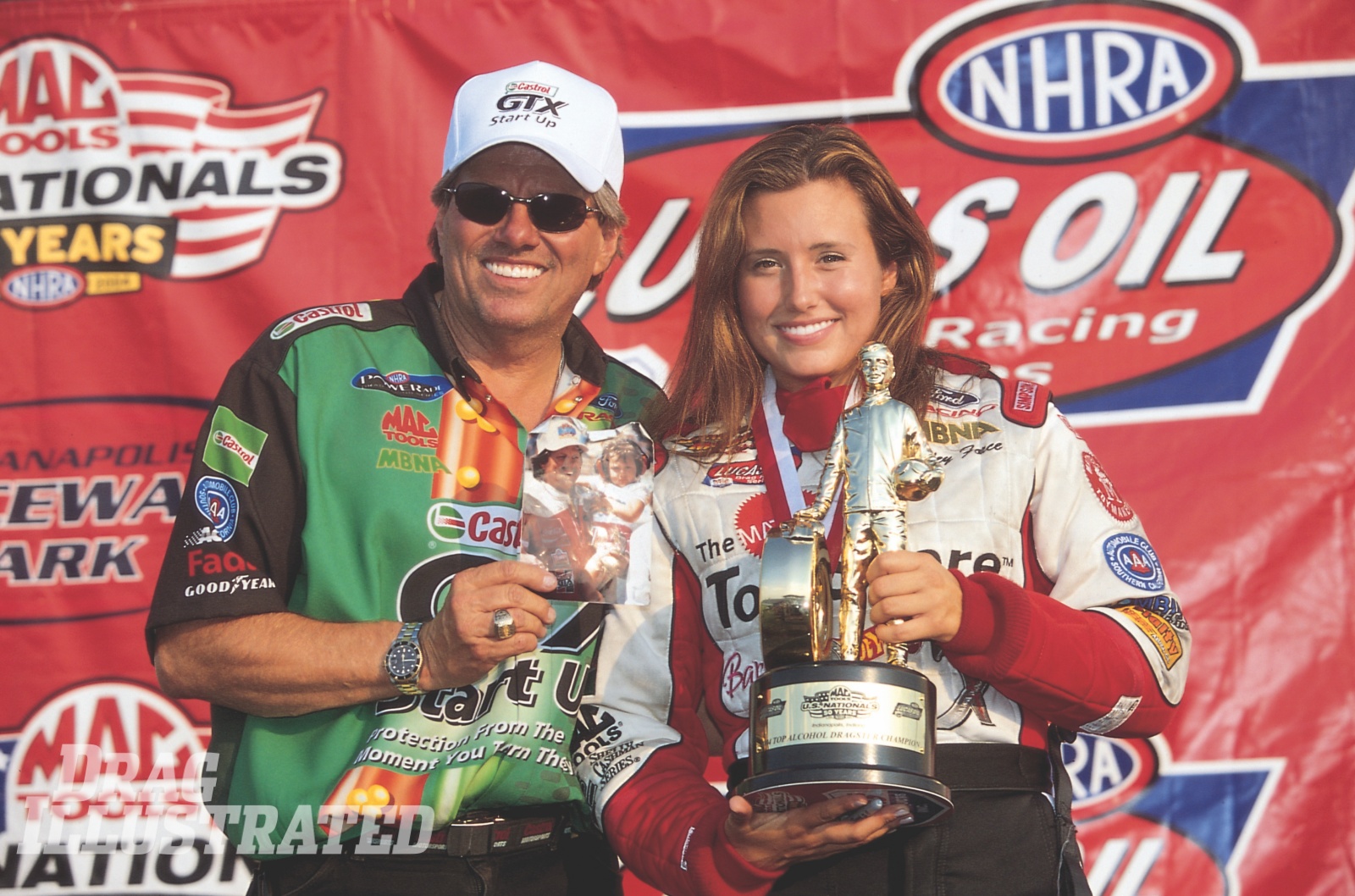
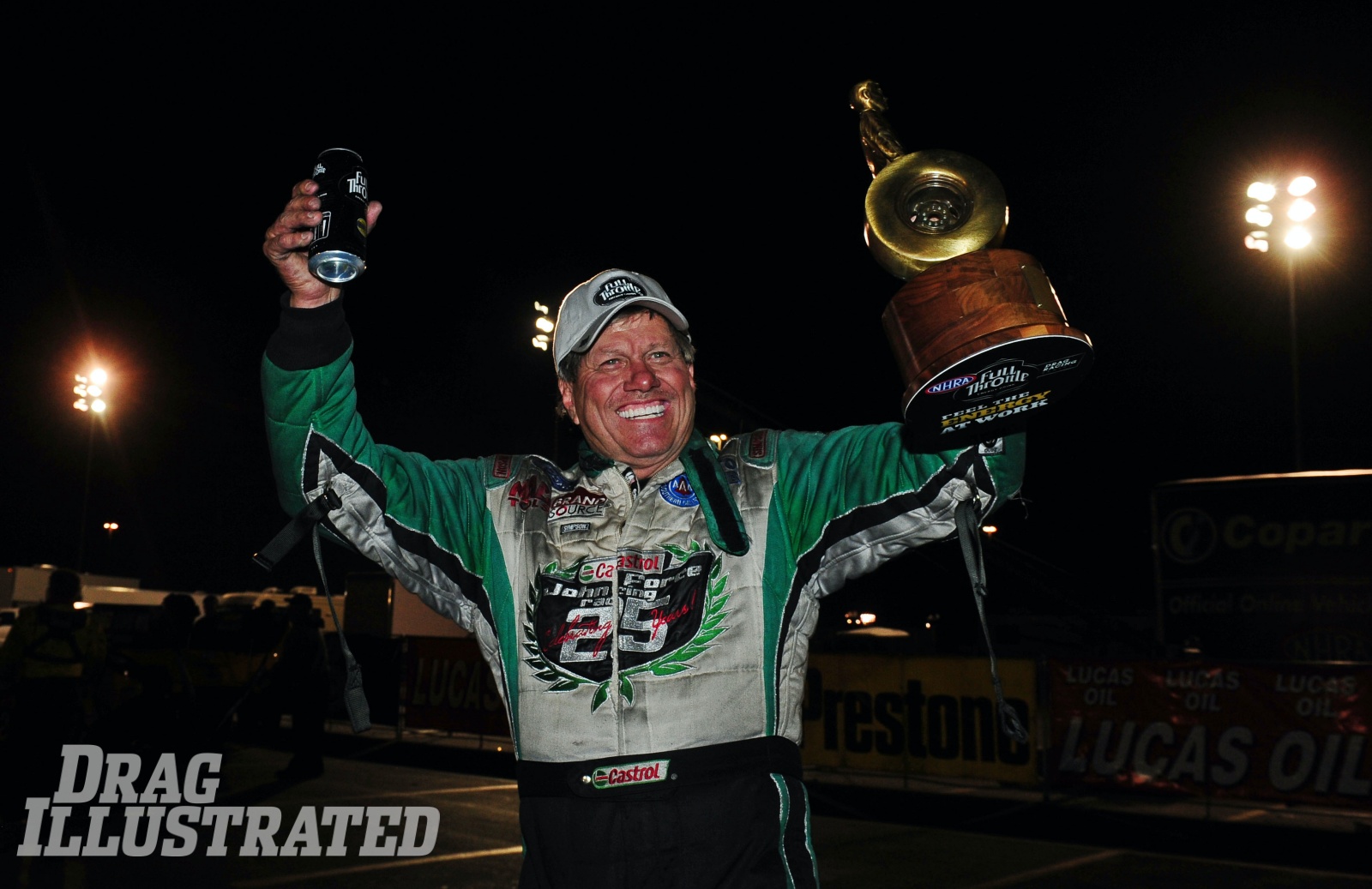
Though his championship-winning performance this past November in Pomona looked much like a perfectly executed plan, Force can’t help but shake his head in amazement when he talks about it. “Beating Hagan,” he says, looking up. “Did that make any sense at all? That everything went wrong for him, and everything went right for me? Think about it. No, it doesn’t. There’s a higher power running this show, and I’ve learned that.”
Force insists he has five years left to drive a race car, and that he’s going to give his fans and his sponsors all he’s got for every last one of them. “There won’t be any big announcement, there won’t be a retirement press conference,” he says. “Some older people want their finals days to relax, and God Bless them. When I step out of the seat, I know that I’m going to have to work harder to run the teams, to grow the business; whether it’s at the racetrack with the NHRA or if it’s in Hollywood.
“I’m 61 going on 100,” he quips. “I will die at a drag strip. I know it’s already in the books, and it’s a good way to end my movie.”
Even when speaking of his own death, Force recognizes an opportunity, and though it may be a tough pill to swallow when his body finally tells him that driving is no longer an option, it’s just one more road to cross. “Believe me, the legend is only beginning,” says Force. “It’s not about me. It’s about the future; it’s about our young drivers, our young crew chiefs. I’ve still got Bernie [Fedderly], and I’ve still got [Dave] Densmore, we’re the last of the old timers, and they remind me where I came from. We’ve got these young kids to take us to the next level.”

Our hour-long meet and greet that had somehow morphed into a marathon confessional was finally winding down. Force has a meeting later this afternoon with Castrol in Los Angeles, which is clearly a priority. The first time he signed with Castrol was in 1985 for $5,000, and now he’s headed to their corporate offices to discuss what is certainly a multi-million dollar deal that will take the two partners into their 30th year together. “I’ve been racing for better than 30 years,” says Force. “It was never about the money. Just like I don’t work in that office upstairs, or live in these big houses I’m embarrassed to own, I don’t race for money or championships. Sure, I’ll take ‘em, and I’m proud, but there’s more to it than that.
“So, what’s the motivation? What do I have left to prove?” he asks, preempting my question. “Nothing. I never did. All I’m doing is chasing the dream.”
For John Force, the dream is simple – to be somebody. It’s been a lifelong quest to hear the crowd roar, and it’s served as both a blessing and a curse; the never-ending pursuit of the next accomplishment and tireless worth ethic keeps the championships coming, the sponsors on board, while the fear of failure and returning to that trailer house in Bell Gardens keeps him from ever truly enjoying his successes.
“You have to understand,” says Force. “It’s where I came from. I was nobody. When I hear the cheer of the crowd, I can’t explain it – Superman comes out of me. It’s an addiction. It’s my ego.”
So there it is, the dream. John Force has spent his whole life hoping, praying, and dreaming that one day he’d matter, that it’d be him the people stood and applauded. Though he’ll never rest, never stop fighting the good fight, Force’s dream came true a long time ago, and even if he called it quits with number fifteen – the crowd will never stop screaming every time they hear his name.
The post DI Classic: John Force’s Dream first appeared on Drag Illustrated.